

There’s a strange part of being an entrepreneur. I’ve come to call it the middle innings. In between the first act — the choosing of this path, and the last act (God knows what that will be), there is this vast expanse where most of the actual work happens.
By this time, your work and mission have settled into your bones. If you’re lucky, you’ve picked a problem that’s hard enough to solve (education) — but if solved, could improve the lives of billions.
And by solved, I do not mean a ‘pretty’ metric. Solved as in gone for good. All children in Pakistan are learning. No one’s out of school. Education is meaningful. The sort of end-state whose attainment you could gut-check with a passerby on the street.
By the time you arrive at the middle innings, you’ve discovered the mirage: the goal seems more and more unattainable the more you work on it. You’ve become feverish, and have toiled away all your energy; the kind that only youthful exuberance can afford, and discovered that trying harder doesn’t always help either.
By the middle innings, the crowd has thinned, too. After all, why do more of this madness? Even your family and friends are annoyed: this obsession should end already. People emigrate, find normal jobs, begin to build houses — the لوازمات (trappings) of life must be served.
But…. you decide to trudge on nonetheless.
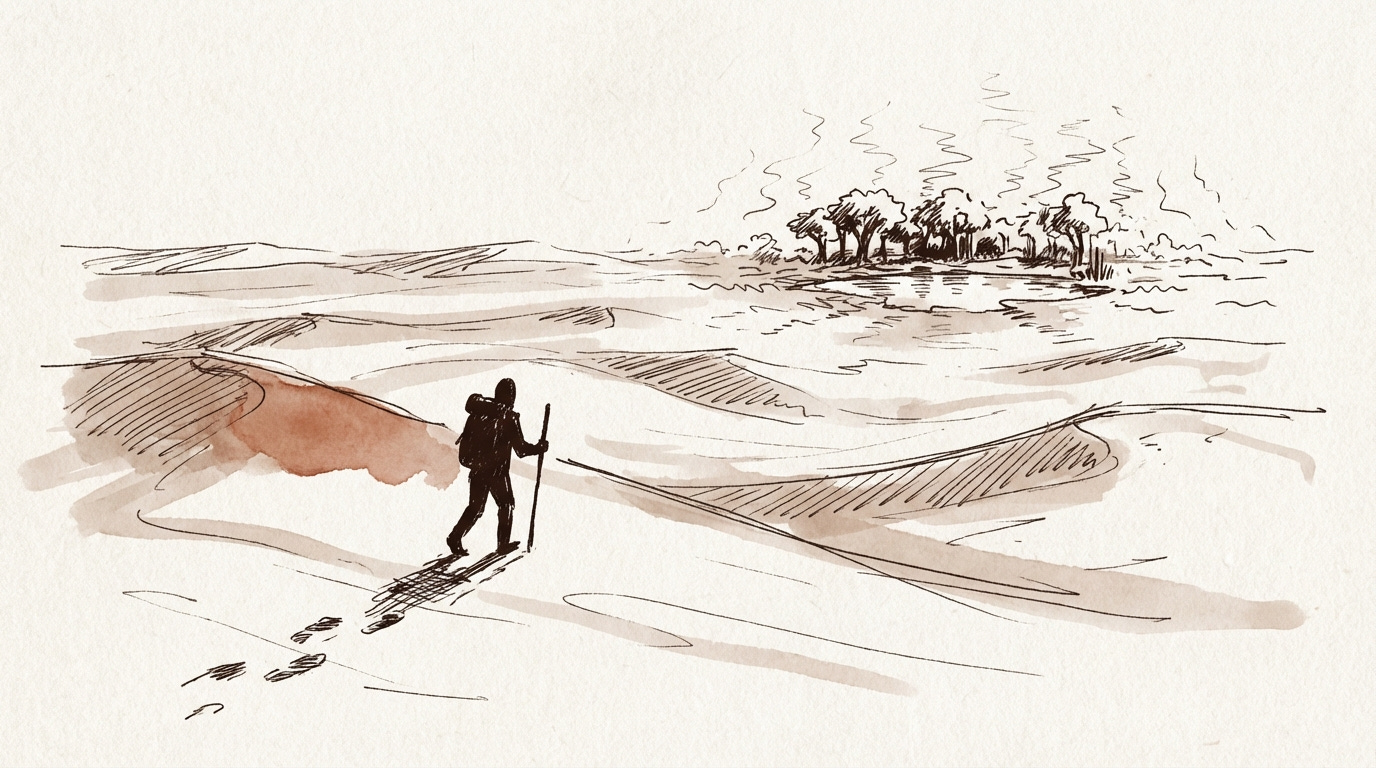
The first thing the middle innings does to you is that you stop treating yourself as the central character. You have tried and realized that no amount of technical, individual, or intellectual brilliance can get you to solve this problem alone.
You need a crew. And so an organisation is born.
But the second, more interesting effect is that you stop treating your organisation as the central character too.
This is harder. You love your organisation: it’s the vehicle of your dreams. Centering it doesn’t feel narcissistic. But at some point, the organisation must lose its centrality for the Mission to move forward.
This is because a Mission is an end-state. A complete resolution of the problem.
If any single firm could achieve that alone, we’d see monopolies on every facet of life. We don’t, because a firm is both insufficient and, beyond a certain size, increasingly inefficient. It can only optimize for one function at a time.
And so if you want to actually solve the problem, you start to treat your organisation as one piece of the puzzle. And you begin to cultivate a garden of organisations.
But what garden of organisations does one cultivate in Pakistan?
Pakistan has a death rate per capita of startups that is astonishingly high. To a certain extent, startups dying is fairly normal…but having spent more than a decade building, I can confidently say these are not the ones that we can write off as evolutionary/growing pains.
The founders are close to the problems they're solving, but either because the positioning is off, or more cynically, because they don't have the credentials of a western college education, they never get into the right room. And as a result, they never find the mentor or partner who could tell them: the unit economics don't work, or your scale strategy doesn't hold up to intense scrutiny and logic.
I had the good fortune of learning from those who’d been through the middle innings before me. Riaz Kamlani at TCF, which runs perhaps the largest network of independently run schools in the world, with over 2,200 schools across Pakistan. Ahson Rabbani at ChildLife Foundation, which treats 1.7 million children every year and saves countless lives in their earliest, most fragile days. Roshaneh Zafar, who built Kashf Foundation’s microfinance enterprise in the ‘90s with steely determination through recessions and political crises, and has now issued over 5.5 million loans to women. David Hylden, who helped lead One Acre Fund’s expansion as it grew to serve millions of smallholder farmers and generate hundreds of millions of dollars in additional income across sub-Saharan Africa.
These were the people who asked the tough questions, but ultimately enabled us to keep moving in the right direction, right through the middle innings.
We don’t want to be the exception. We’d rather open the doors for younger entrepreneurs. Because the difference between social impact that dies in its infancy and impact that grows into a TCF or a Kashf or a ChildLife Foundation is often… just access to the right people at the right time.
Passing the ball at a global conference was a start. But the harder question was this: how do you build the room in Pakistan itself? Over time, many of us started having the same conversation. Eventually, we stopped bumping into each other like strangers in foreign rooms in foreign countries and started asking: what if we built the room ourselves?
One of the paradoxical consequences of the middle innings is that once you accept a hard problem, you begin to look for other hard things too. At some point, I got into mountaineering.
Pakistan is home to some of the tallest mountains on Earth. Gilgit-Baltistan in the north is called the ‘third pole‘ for the sheer amount of ice and glaciers it holds. I had spent my 30th birthday staring at Tirich Mir, spellbound. A few years later, I sat in front of K2 after a seven-day trek across one of the most remote terrains on the planet. Every new visit pulled me in further.
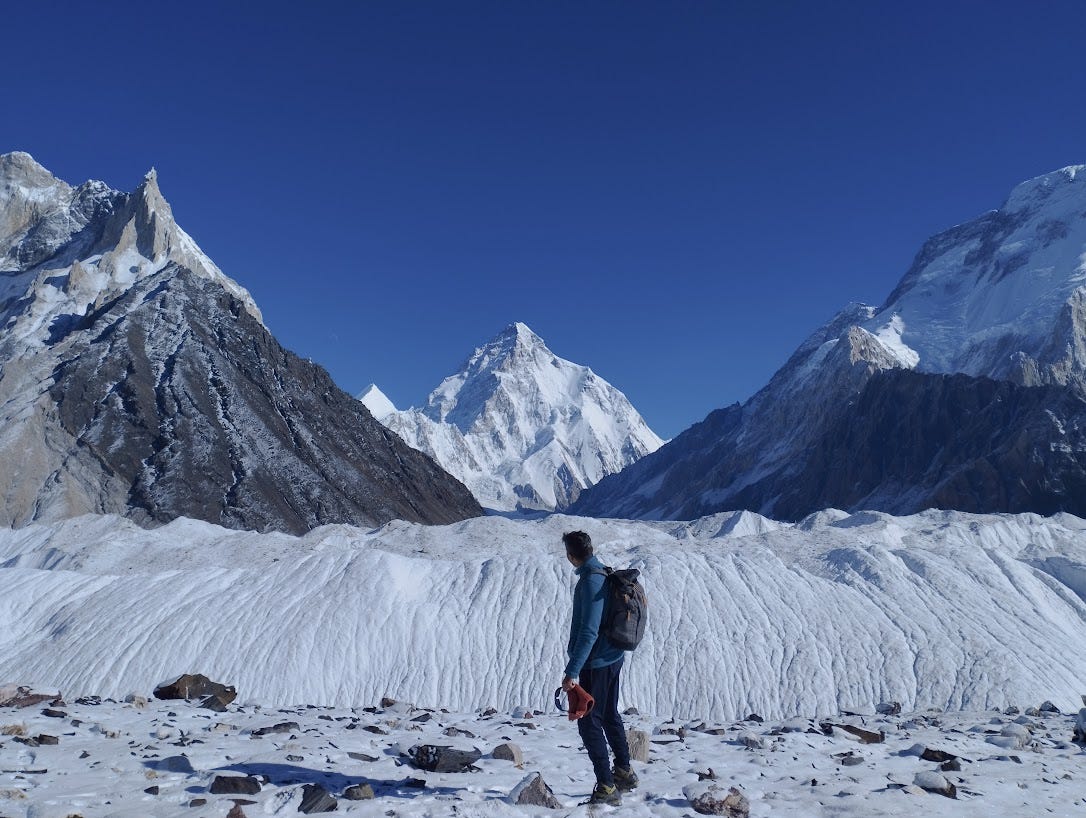
I went to the mountains because I yearned for the company of absurdists. I found them on every expedition.
What mountaineering and entrepreneurship share in common is a love for excruciatingly hard things: the audacity of chasing a painful goal knowing what’s at stake, while relishing the journey of getting there.
This is about continuing that tradition. Gathering a group of misfits and absurdists and heading to the mountains again... but this time, to build something together.
This summer, in Skardu, we’re running the Summit Fellowship: a 7-day residential intensive for 10–12 Pakistani founders.
The Pakistan Collective is a group of us. Pakistani social entrepreneurs who’ve either grown our organisations to serious scale or have crossed the existential early phases into the middle innings. We’ve come to realize, painfully, that the number of such organisations needs to be drastically bigger if we want to see Pakistan’s problems in health, education, and livelihoods solved (as in, Mission accomplished). The same people who asked us the tough questions are now in the room to ask them of the next generation.
The intellectual backbone of the fellowship is built on what Kevin Starr at Mulago calls the Scale Screen, four tests every intervention must pass: Good enough? Big enough? Cheap enough? Simple enough? It sounds simple, but it is not. Most organisations have never been asked these questions this directly. Kevin and the Mulago team are partners in putting this together, bringing a curriculum refined over twenty years of funding solutions that have reached tens of millions of people, and in some cases, eliminated the problems they set out to solve entirely.
Founders arrive with working models and real evidence. Over seven days, they stress-test every assumption, with the well-versed faculty pushing back (and hard). In an era of bite-sizedness, we’re choosing to go deep.
By the end of the week, each founder emerges with a Scale Blueprint, a concrete, defensible plan for reaching millions, which will be presented to a small room of funders who have funded/supported Taleemabad and have an established intent to fund in Pakistan. Eventually, this blueprint travels the world and brings crucial attention to Pakistan.
We chose Skardu because what better way to introduce this giant of a country than at the foot of the most imposing structures on the planet? Four of the world’s five highest peaks are in this district: K2, Broad Peak, Gasherbrum I and II.

And what better place to talk about absurd goals than sitting at the base of these mountains?
If you’ve read this far and felt something familiar about the middle innings, then you might belong in this room.
If you’re a founder: You have a working model. You have initial evidence that it works. You’ve gotten past the first act, and you know, with some clarity, that the next step is to think seriously about scale for the first time. You’re building in Pakistan, working on a problem that matters, and you’re looking for the kind of rigour and challenge that your current environment probably can’t provide.
If you’re a funder: You’re genuinely interested in deploying capital in Pakistan. Not curious in the abstract, but ready to act. You want to spend real time with founders. You want to understand their models at the level of detail that lets you make real decisions.
If you’re neither, but you know someone who fits: Forward this to them, or send me a message on LinkedIn with an introduction. That might matter more than anything else on this page, because discoverability seems like a genuine problem for Pakistan’s pipeline.
We’re keeping the numbers small. Roughly 10–12 founders, matched with a curated group of funders. The founder cohort is selected through an application process.
Applications are open and close on the 25th →
I’ve probably taken a long-winded route to get here. But the middle innings teaches you that the most important work is not the work you do yourself. It’s the rooms you build for others.
If you know someone who should be in this room, send this to them.
— Haroon, on behalf of the Pakistan Collective
Haroon Yasin is the co-founder and CEO of Taleemabad, which works to improve learning outcomes in public schools in Pakistan. He is a 2025 Skoll Fellow, a Queen’s Young Leaders Award recipient, and a WISE Award winner. His body lives in Islamabad and his heart in the Karakoram.
This really resonated with me. The idea of “passing the ball” in the middle innings feels both humbling and meaningful. It reminds us that real impact often comes from enabling others, not just doing more ourselves. In places like ours, where so much potential exists, this mindset can truly make a difference. Looking forward to seeing how this unfolds.
Godspeed! May you and the people around you build towards the future you envision.